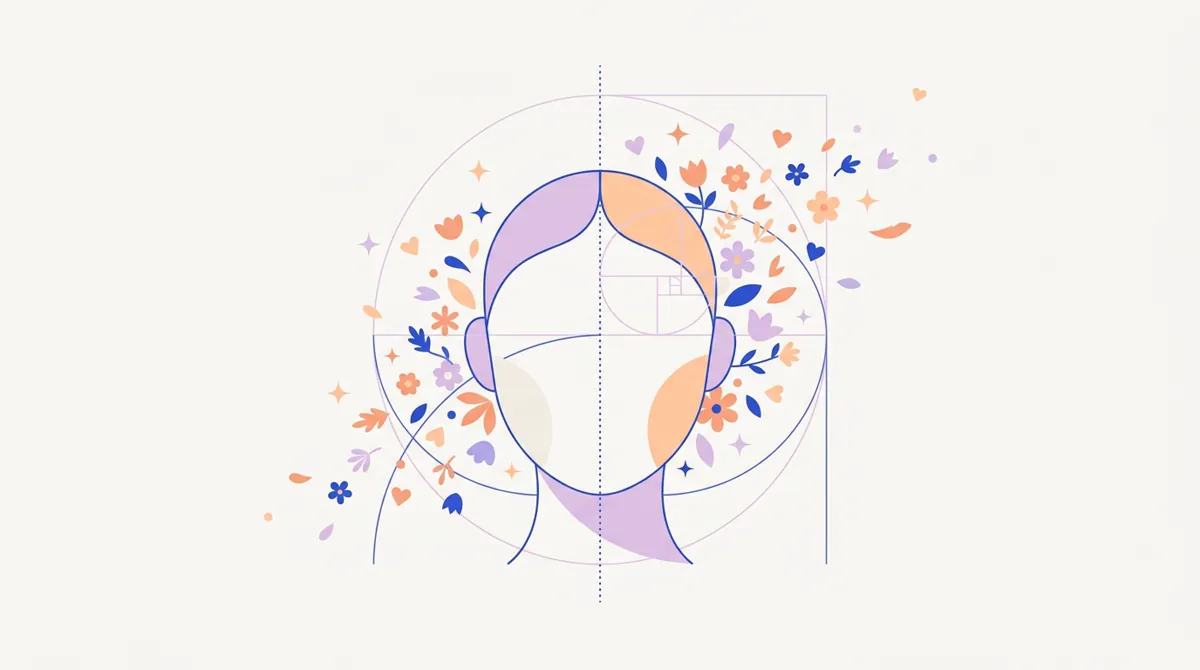
Many “beauty tests” online give your face a score out of ten. We do not. Attractiveness depends on far more than geometry, and a number from an algorithm says nothing about your worth. What a photo can show is how symmetrical your face is and how its proportions compare with classical artistic rules. That is what this test measures, with every number explained.
Free · No sign-up · Runs on your device
Upload a straight-on photo with a neutral expression. We measure facial symmetry and compare your proportions with classical rules.
- Your photo stays on your device. It is analysed in your browser and never uploaded to us or anyone else.
- Nothing is saved. Close the page or press "Remove my photo" and it is gone.
- Open-source models. Your browser downloads the model files once; see how our photo tools work.
What The Test Measures
Symmetry. We mirror 14 pairs of matching landmarks, such as the corners of your eyes, your eyebrows, your mouth and your jaw, across the centre line of your face and measure how far each pair is from a perfect match. Small differences are completely normal.
Proportions. We compare four of your ratios with rules artists have used for centuries:
| Measure | Classical rule |
|---|---|
| Middle third vs lower third | Brow to nose base equals nose base to chin |
| Eye width vs gap between the eyes | The gap equals one eye width (the rule of fifths) |
| Upper lip area vs chin area | The mouth sits about a third of the way from nose to chin |
| Face length vs width | About 1.6, the so-called golden ratio |
What Research Says About Beauty
- Averageness: in a well-known 1990 study, Judith Langlois and Lori Roggman blended photos of faces and found that composite “average” faces were rated more attractive than most individual faces.
- Symmetry: studies by Gillian Rhodes and others found that people tend to prefer more symmetrical faces, but perfectly symmetrical faces, made by mirroring one half, often look strange or less attractive.
- The golden ratio: popular claims that beautiful faces follow the golden ratio have weak scientific support. Studies have not found it to be a reliable predictor of attractiveness.
- Beyond geometry: expression, skin, grooming, voice, confidence and kindness all shape how attractive people seem. Research on familiarity also suggests we find faces more attractive the more we see and like them.
Why Nobody Is Perfectly Symmetrical
Faces develop from two halves that grow slightly differently, and life adds more variation through things like dental work, injuries and ageing. Most people’s faces show small but measurable asymmetries. Your phone’s selfie camera often flips your image, which is one reason your own photos can look “off” to you when other people see nothing unusual.
How To Read Your Result
- Symmetry above about 85% is typical for a straight-on photo. Head tilt, turning and expression lower the score, so retake if you were not facing the camera directly.
- Proportions show how close your ratios are to the classical rules, not how attractive you are. Many striking faces break these rules.
If This Test Worries You
If you find yourself checking your appearance often, comparing yourself constantly or feeling distressed about a feature others barely notice, talk to a doctor. These can be signs of body dysmorphic disorder, a common and treatable condition.
Frequently Asked Questions
Does a high symmetry score mean I am attractive?
Not on its own. Symmetry is one small factor among many, and very high symmetry does not guarantee attractiveness.
Why did my score change between photos?
Small changes in head angle, expression and lens distortion change the measurements. Use your highest-quality straight-on photo.
Is my photo uploaded?
No. All measurements happen in your browser.
Related Tools
Try the face shape detector, our self-esteem test or all photo tools.
For curiosity only. Not a measure of attractiveness or worth, and not a medical or cosmetic assessment.