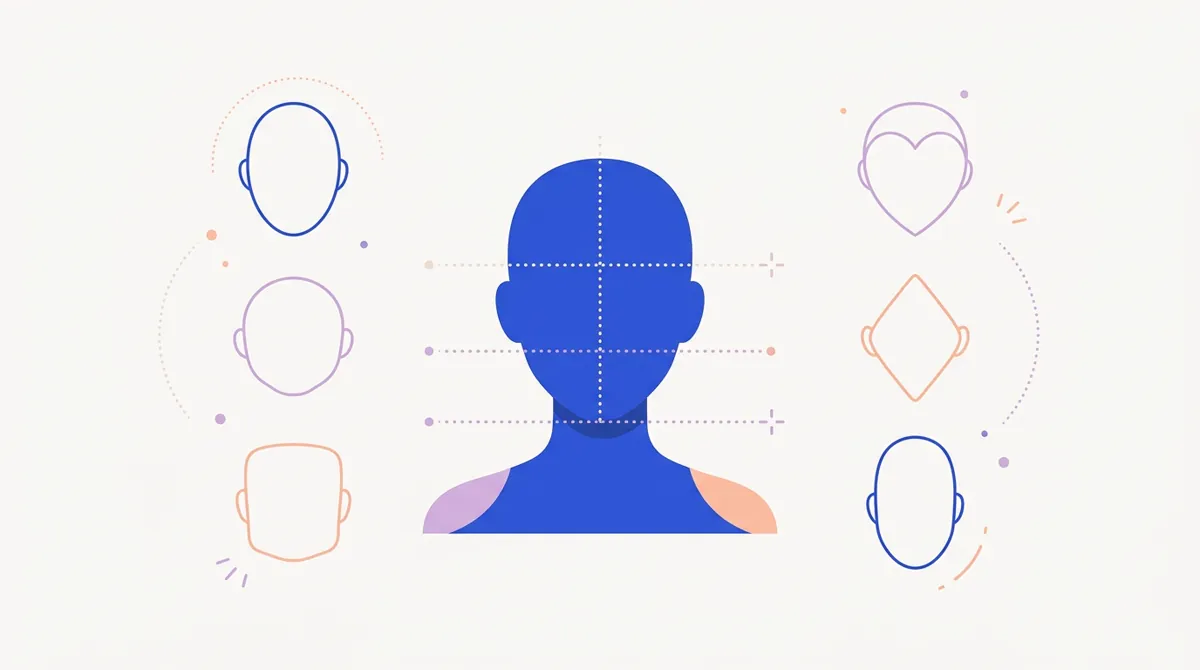
Knowing your face shape makes choosing a haircut, glasses or beard style much easier. This detector measures your face from a photo in seconds, entirely on your device, and shows you the numbers it used.
Free · No sign-up · Runs on your device
Upload a clear, front-facing photo and we measure your forehead, cheekbones, jaw and face length to find your face shape.
- Your photo stays on your device. It is analysed in your browser and never uploaded to us or anyone else.
- Nothing is saved. Close the page or press "Remove my photo" and it is gone.
- Open-source models. Your browser downloads the model files once; see how our photo tools work.
How The Detector Measures Your Face
The model places 478 points on your face. We use them to take four measurements, after first levelling your head so a slight tilt does not skew the result:
| Measurement | Points used |
|---|---|
| Forehead width | Across the upper temples |
| Cheekbone width | The widest points at the sides of your face |
| Jaw width | Across the angles of your jaw |
| Face length | Top of the forehead to the tip of the chin, adjusted for the hairline |
We also measure the jaw angle: how sharply your jaw turns from the sides of your face towards your chin. Each ratio is compared with typical adult values, and the shape that fits best wins. You also see a close second, because many faces sit between two shapes.
The Six Face Shapes
| Shape | Key signs |
|---|---|
| Oval | A little longer than wide, jaw slightly narrower than forehead, soft curves |
| Round | Width close to length, full cheeks, soft jaw |
| Square | Forehead, cheekbones and jaw similar in width, angular jaw |
| Heart | Wide forehead, tapering to a narrow chin |
| Diamond | Cheekbones widest, forehead and jaw narrower |
| Oblong | Clearly longer than wide, fairly straight sides |
Measure Your Face By Hand
Want to double-check? Stand in front of a mirror with a soft tape measure:
- Forehead: across the widest part, halfway between brows and hairline.
- Cheekbones: across the most prominent points, just below the outer corners of your eyes.
- Jaw: from the angle below one ear to the same point on the other side.
- Length: from the centre of your hairline to the tip of your chin.
Compare the four numbers using the table above. If two measurements are within about a centimetre, treat them as equal.
What To Do With Your Result
- Hair: balance your shape. Add height for round faces, width for oblong faces and softness for square ones. Our hairstyle changer shows which cuts tend to suit your shape.
- Glasses: choose frames that contrast with your strongest lines, such as round frames for angular faces and angular frames for round faces.
- Beards: a fuller chin beard lengthens a round face; shorter sides suit an oblong face.
Why Results Can Vary Between Photos
Lens distortion is the big one. A phone held close to your face exaggerates the centre and shrinks the sides, which can make a face look longer. Take the photo from arm’s length or further, keep your chin level, pull your hair back and try more than one picture.
Frequently Asked Questions
What is the most common face shape?
Oval is often described as the most common and the most balanced shape, though many people are a blend of two.
Can my face shape change?
Bone structure is stable in adulthood, but weight changes and ageing alter soft tissue, which can shift how your face reads, especially around the jaw.
Is my photo uploaded?
No. The detector runs in your browser and your photo never leaves your device.
Related Tools
Try our Kibbe face lines analysis or AI colour analysis, or see all photo tools.
For styling inspiration only. Results depend on photo quality and are not a professional assessment.