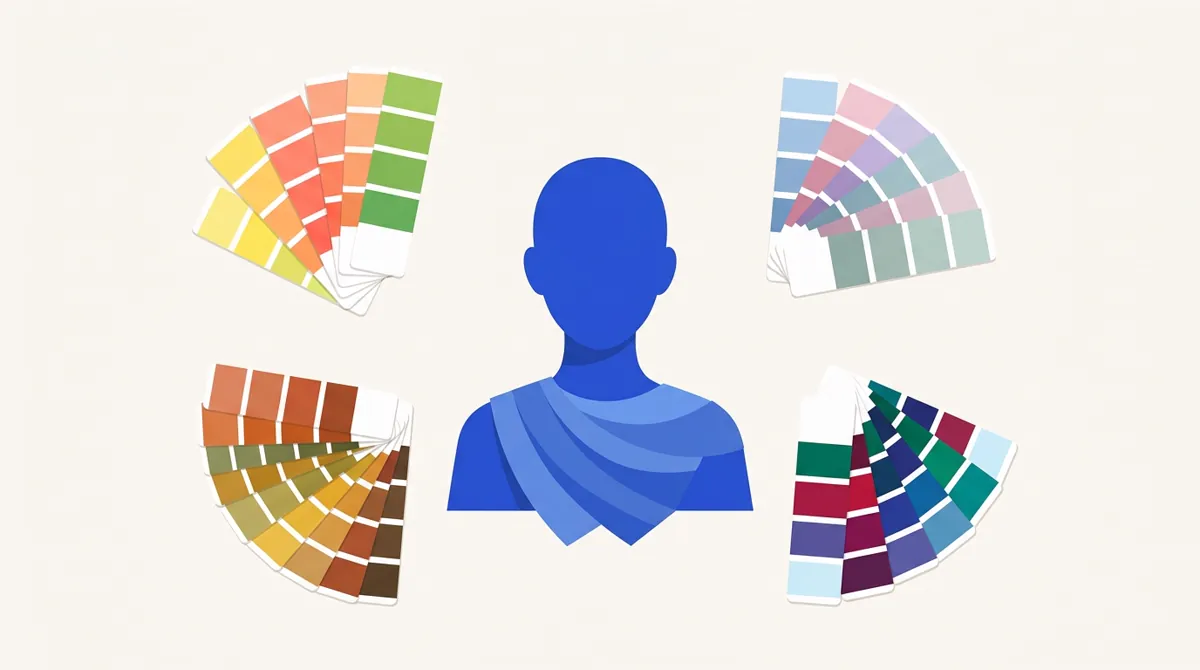
Personal colour analysis matches the colours you wear to your natural colouring. A professional session drapes fabric swatches under your chin in daylight. This tool does a quick digital version: it samples your skin, eyebrows and eyes from a photo and places you in one of the four classic seasons.
Free · No sign-up · Runs on your device
Upload a photo taken in daylight without heavy make-up. We sample your skin and brows to estimate your undertone, depth and contrast.
- Your photo stays on your device. It is analysed in your browser and never uploaded to us or anyone else.
- Nothing is saved. Close the page or press "Remove my photo" and it is gone.
- Open-source models. Your browser downloads the model files once; see how our photo tools work.
What The Tool Measures
| Measure | How we get it | Why it matters |
|---|---|---|
| Undertone | The hue of your skin, sampled from cheeks and forehead | Warm undertones suit golden colours, cool undertones suit blue-based ones |
| Depth | How light or deep your skin is | Deeper colouring carries richer, darker colours |
| Contrast | The difference between your skin and your eyebrows | High contrast suits bold combinations; low contrast suits blended ones |
| Eye colour | Measured from your irises | Light eyes usually go with the lighter, softer seasons |
The Four Seasons
| Season | Colouring | Best colours |
|---|---|---|
| Spring | Warm, light and clear | Coral, peach, warm yellow, turquoise, camel |
| Summer | Cool, soft and light | Powder blue, lavender, rose, sage, slate |
| Autumn | Warm, deep and muted | Rust, olive, mustard, teal, chocolate |
| Winter | Cool, deep and high contrast | Black, pure white, royal blue, emerald, crimson |
Where The Seasons Came From
The idea of grouping colours into seasons is often traced to Johannes Itten, the Bauhaus colour teacher, who noticed that students chose colours that harmonised with their own complexions. It reached a mass audience with Carole Jackson’s 1980 book Color Me Beautiful, which sorted people into four seasons. Later systems split each season into three, giving the 12 seasons used by many analysts today, such as “light spring” or “deep winter”.
There is little formal scientific research on seasonal colour analysis. It is best seen as a practical styling framework rather than a proven theory, but many people find it useful for shopping and make-up.
Check Your Undertone At Home
- Vein test: in daylight, veins on your inner wrist look greener with warm undertones and bluer with cool ones.
- Jewellery test: gold tends to flatter warm undertones, silver cool ones.
- White test: pure white flatters cool colouring; cream and ivory flatter warm colouring.
If none of these give a clear answer, you may be neutral, and you can borrow from neighbouring seasons.
Getting A Reliable Result
Colour readings are very sensitive to light. A warm indoor bulb can turn anyone into an autumn, and a cold screen glow can make anyone look like a summer. For the best result:
- Sit facing a window in daylight, out of direct sun.
- Wear no make-up, or very light make-up, and no tinted moisturiser.
- Turn off filters, portrait modes and beauty effects.
- Wear white or grey near your face.
Frequently Asked Questions
My result does not feel right. What should I do?
Try a second photo in different daylight. If results differ, look at the measurements: undertone is usually the most important, so start from whether warm or cool colours feel better on you.
Can my season change?
Your undertone generally stays the same, but hair colour, tanning and ageing change your contrast, which can move you towards a neighbouring season.
Do you keep my photo?
No. The analysis runs in your browser and nothing is uploaded.
Related Tools
Try our seasonal colour analysis quiz, the eye colour detector or virtual make-up try-on.
For styling inspiration. Screen colours and lighting vary, so check palettes in daylight before buying.